Saturday, 18 January 2025

Healing happens in Stillness

 "Beginning therapists must learn that there are times to sit in silence, sometimes in silent communion, sometimes simply while waiting for patients' thoughts to appear in a form that they may be expressed."

Irvin D. Yalom, The Gift of Therapy


Some clients come to us with a narrative that is self-generating to the extent that their story is expelled fast and relentlessly.  They want to tell how it is for them and the material is infinite.  As a therapist you may interject to ask questions, to challenge inconsistent re-tellings, to pause and take a moment to assess and validate the impact of a life-event.  As a good therapist, you will pause the session and try and find some stillness in silence with your client, to ask them what is happening in their body, something they may have disconnected from long ago.  There is an irony that in talking therapies it is the stillness and silence that can often speak most loudly.  

But why?  

The story will have been told many times, if only in the client's head.  It will have been told so many times that the emotional narrative has receded.  The story itself has become a distraction from the emotions that once cleaved to it. As psychotherapists we are emotion-hunters.  Your words are important, how you tell your story is important to us but only as a dossier of clues that, in time, we hope will lead us to the client's emotions.  Emotions, when we are experiencing them, can be very exposing.  They can feel out of our control and that makes us feel vulnerable. We live in a world where rational thought is prized above all else as a means of decision-making and moving forward in a cohesive, sensible manner.  And yet, studies suggest that we are mostly making decisions (about 95%) for impulsive, intuitive reasons that we like to dress up with rational explanations and justifications.  In this way, who can forgive us if we have buried the emotional wound, the emotional outburst waiting to happen?  We have been talked out of our emotions since we were very small.  There are extreme and traumatic consequences to this in childhood - children who are told they are safe when they are not, children who are told to override how they feel to make others feel better.  However, for most of us there is just a slow process of distancing from what we think may hurt us and what we have been lead to believe is an unnecessary part of human existence.  We strive to move through life emotion-less and we may, at times, achieve this.  When the career that we have spent some time constructing starts to provide us with stimulating work for which we are highly remunerated, we may throw ourselves into that world, body and soul.  Society will applaud us for our productivity, for the way we are contributing whilst making ourselves financially independent and therefore untouchable.  But the workaholic is not so different from the alcoholic.  Neither is an addict first and foremost; the workaholic just picked a more acceptable and enabling way of numbing.  Because the workaholic also has funds, which means in his spare time he can afford to go and visit European cities, jump out of aeroplanes, eat in elite restaurants.  He can mix up the distraction.  

Until one day a small crack appears.  Maybe he feels too tired to jump out of another aeroplane, maybe he looks back and wonders where all his friends went, maybe his parents die, maybe his back seizes up.  Quite suddenly the distraction does not seem enough; emotions, particularly those that we deem negative - sadness and fear - start to seep into our lives.  Perhaps we visit a therapist to ask what on earth is wrong with us.  We will hope that the therapist has a way of putting the feelings into some kind of airtight container and burying them at sea.  It feels preposterous that what the therapist will ask of us is that we try, slowly and with courage we don't think that we have, to get closer to the emotions.  We must move forward with curiosity and faith; faith that they will not overwhelm us.  At first, even a hint of feeling may cause us to weep and wring our hands, may even induce a panic attack.  Our body and mind are screaming at us to get away.  Perhaps we do but it is important to understand that we cannot regulate what we cannot feel.  Those feelings will continue to loom large like monsters until we practice feeling them.  Only then will they start to shrink.  When we move away from our distractions into stillness, even if it's for only ten minutes of mindfulness a day, we allow ourselves to get better acquainted with our emotions.  A whole bank of understanding exists within our sentient selves, a whole new way of experiencing the world that we have not allowed to flourish.  We have survived on thought and reason for so long, we have imagined that it is the only way to decode the world around us.

It is worth mentioning that when we numb ourselves with distraction, which we all do to some extent because too much reality is brutal, we cannot choose to only numb the sadness and the anxiety. We will also numb the higher range of joy that can be present in life.  We are literally dialling down the frequency on all our feelings.  When we learn this new language, when we practice it daily, we will find that it enables us to communicate with the world around us in a way that enhances our lived experience and makes us feel fully alive.

Tuesday, 5 November 2024

Bonfire Night, 2024

Bonfire Night, 2024


Lately, I have been very busy.  It’s not great for me physically.  It’s almost as if, in summoning the energy to do all the things that must be done, the fun as well as the obligations, I have no off-switch; I must have the energy coursing through me at all times, even at night.  However, today is a gentle day and I managed a decent seven hours of sleep so I have some mental space, and physically I am relaxed, the jitters have stopped.  What I realise is that in the busy, anxious, over-excited state I am very hard and sinewy, stopping for no man.  Once I quieten and become more meditative, I can allow myself to soften.  This is how I prefer to feel, I think.


It is November.  I hardly remember the woman from January who was so frightened, who flinched constantly when her soul was stinging, who was overwhelmed and fragile and could not see a future, in any form, where she didn’t feel that desolate.  Where I am now, it is hard to say what I feel because compared with that time, I feel so little. Of course, I was never going to feel in such high intensity forever.  I say, ‘of course.’  I say ‘of course’ from this comfortable, end of year vantage point.  I say ‘of course’ as if January-Kate were only an apparition of naiveté.  November-Kate, with all her sophistication, her self-knowledge, her intrepid journeying into independence, has almost lost sight of January-Kate.  Do we always look forward?  I am where I was going and it feels like the right sort of place.  I’ve arrived at myself.  I’ve made the house cosy and not too shabby.  I’ve asked for very little help.  I’ve painted and fixed and come alive in seeing the transformation to home.  I no longer need to be elsewhere.  And I suppose the thing to do when you arrive after a long journey is to enjoy, luxuriate even, in the halcyon days of homecoming.  Perhaps I am doing this.  I am having fun after all.  The kind of fun I am having is still novel, inaccessible as it has been to me.  The fun you all had in your twenties.  But still, I ask myself, what next? What next?


Does there need to be a ‘what next’?  Perhaps I just carry on.  What I can’t understand is how lonely I was in the last five years of my marriage.  I left because I thought I would die of loneliness. Truly, I didn’t think I could stay alive but now here I am, November-Kate and I am not lonely. And yet, I am alone, on my own. I am single.  I have cultivated deeper friendships than I had before, certainly. And I have cultivated them with more authenticity because I am a pared down version of myself, with fewer places to hide.  My children tolerate me with palpable affection, my lovers are attentive but today I have wondered, could I not have had these connections from a different home?  I am the same but different, as if I find myself thinking, after all, it was so easy.  Of course, it wasn’t easy, it was traumatic and disorientating but now I am here, so much myself, I am almost deflated, as if to realise that all I ever needed was to find myself and listen very carefully, then let go and plunge forward with the current.  How strange to have been so scared.

Monday, 14 October 2024

The Monster

The Monster


My grandparents’ house was a 1920’s semi with an impressive, curved bay window at the front, stained glass in the door and a small kitchen at the back of the house, added on as an afterthought, as if cooking and feeding a family weren’t the hugely involving occupation that it actually was.  It seemed a dark house to me and I was always grateful that when I was inside it there were lots of people crammed in to make a noise.  I felt that it would have been a desolate space when it was empty, somewhere I might’ve held my breath and trod very carefully.  We were not so close to my father’s family because my father was not close to anyone and only maintained relationships due to the work that my mother put in, hosting Sunday lunches and Christmases for his four siblings and his five children, two of which were hers.  In addition to my mother’s efforts there would be a bi-annual tea at my grandparents’ house.  By the time I, and then my sister, came along, my father’s second family, my grandparents were elderly.  Or rather, my grandmother, some sixteen years older than her husband, my father’s step-father, was elderly.  She seemed to find movement difficult, or an inconvenience, so the work of hosting fell to my grandad.  He was more than up to the task.


The food was always the same, plentiful and traditional.  These teas were when I got to eat two things that I did not get to eat on any other occasions that I can remember.  Firstly, pickled onions.  A pickled onion with cheese is one of life’s greatest pleasures.  To a child raised on a bland palette, the spicy heat of the onion cutting through the creamy mustiness of the cheddar made my eyes water.  My father would always say how much he liked pickled onions as he and I made a beeline for them as soon as tea was served.  But for some reason they never found their way into our own home.  The second treat was a sherry trifle.  Trifle has all the elements of any great pudding, that is to say, cream, custard, sponge and fruit, with the added indulgence of alcohol.  Why we do not eat trifle so much as a nation, I cannot understand.  I was a greedy child and I am a greedy adult.  I think because I was raised by my mother who is a born puritan, I took any opportunity as a child to fill my boots.  The temptation that trifle presented was why it never made an appearance on our kitchen table.  Anything with that much cream would have been considered downright sinful by my mother who worshipped at the alter of Rosemary Conley and aimed to cut every type of fat out of her own diet and that of her household.  Small amounts of sugar were allowed as a treat.  A few squares of chocolate on Friday, sometimes even milk chocolate!  Otherwise, indulgence was restricted to Rich Tea biscuits which my mother bought religiously because ‘nobody likes them very much, so they will last’.  I think of my mother saying this with great conviction and I think that nothing sums up her character more than her attitude towards biscuits – it is advisable not to have what you really want or what you really enjoy because you might lose your mind.  Instead, there was safety and therefore comfort, in the bland snap of a Rich Tea biscuit.  Because yes, sometimes, she would snap them in half so as to pace her already measured pleasure.  Nothing divides our characters more than this attitude to pleasure.  Whether I am as I am as an act of rebellion is hard to say but it certainly explains the residual guilt I often feel after any form of pleasure.  If the world was ending soon, I’d be shovelling huge, dense mouthfuls of trifle in my mouth, delirious with the thought that I’d die before the guilt set in.


Despite my gluttony, these family teas exist in my memory as quite glamourous affairs.  Indeed, there is undoubtable glamour in trifle; not a beige, steaming pile to be obliterated by gloopy custard, as we traditionally know the English pudding but an exquisite feast of blood red fruit suspended in shiny jelly, layered elegantly and aesthetically with sponge, cold, set custard and then pillowy, velvety whipped cream on top, perhaps with a scattering of flaked almonds for the truly sophisticated consumer.  All served in a trifle dish which, still today, I consider as a particularly curvaceous and beautiful piece.  I keep the sherry trifle alive but my own children are less enamoured, seeming not to understand a pudding if it does not consist of chocolate in some form.  But I’ve said too much about trifle because the food was only part of the experience of these gatherings.  They were a chance to see relatives who I did not know well, in their natural habitat.  My father had two brothers and two sisters, all of whom were quite different from him.  For a start, my uncles and one aunt smoked cigarettes as if they were their life source.  My father has always been strongly risk-averse and could never inhale smoke into his lungs, or do anything at all that was bad for his physical health.  In this way, and perhaps only in this way, he and my mother were aligned. But my father’s siblings would stand around in the tiny kitchen, blowing their smoke out of the back door and chatting their chat which was full of a dry humour that seemed effortless and cool, with none of the intensity that flavoured my father’s talking.  My aunt is still the most glamourous and amusing woman I know.  She quit the cigarettes before they killed her but unfortunately they got the better of my father’s older brother, killing him before he reached sixty.


Whilst the grown-ups were engaged with their talk, we children would run from the front sitting room, where my mother and other aunt would sit with my granny, to the dining room where we would stop and stare briefly at the food laid out on the enormous, oval, mahogany table, to the kitchen and back again, in the frenetic way of a pack of children.  We rarely ventured upstairs.  Upstairs was unnaturally silent.  Because all the doors were shut, the landing was in darkness.  Occasionally, my Aunt Judith would take my baby cousin Rose upstairs to change her nappy, or try and get her to sleep in one of the bedrooms that I’d never seen inside.  As in all large families, there is nearly always an unspoken command of ‘don’t wake the baby’ that may have explained why we rowdy cousins didn’t bound upstairs to continue our games.  As soon as one of us so much as stepped foot on the staircase in the hall, we became cowed and whispering, as if crossing a boundary to an unknown territory where we were suddenly unsure of the rules of play.  But there was an occasion, I think I must have been about six or seven, when we became more daring.  The consequences of this risk-taking were, I recall, absolutely terrifying.


My grandmother always had a lodger.  This was very common, I think, after the second world war and for some decades afterwards.  Not that people don’t have lodgers today but back then, particularly amongst the working class, a spare room was seen as wasted potential.  The idea of not putting somebody in there and charging money was a frivolous oversight.  Lodgers, as I recall, were always men.  Looking back, it seems perfectly reasonable that we children would be stopped from taking our noise on a rampage upstairs when there was a paying guest trying to enjoy some peace and quiet in their own room.  At the time, however, these men were an ominous presence.  We never saw them.  We were told, sometimes, that they were at home but we never saw them come or go.  We never heard anything from the room at the top of the stairs that they stayed in.  One lodger, for some undisclosed reason, or undisclosed to we children, my grandmother thoroughly disliked.  Women of a certain age speak their minds because my other granny was exactly the same; if they feel dislike towards someone, they speak it; not to their victim’s face but in the course of gossip, never fearing that this might come across as ungenerous or unkind.  My granny would say that her current lodger was a monster.  She said it with a dramatic, lip-curling disgust.  To me, as an anxious child, I took this description very literally.  Upstairs in the house where we played, resided a monster.  But fortunately, the monster was contained in his own realm and we never saw him.  As a concept, he was so separate from the family that it seemed he was not really a living, breathing presence but more, as my grandmother put it, a creature from a fairy tale.  


Until, one day, he was real.  In a game that must have made me so giddy as to forget, temporarily, the dangers that lurked high up in the house, I ran towards the top of the stairs, laughing so that laughter took over my whole body.  My cousin Jess running after me, shrieking as well, neither of us really aware that we were edging further and further up the staircase.  Suddenly, and I registered it on Jess’s face before anything else, the door of the lodger’s room opened and standing up there above me and looking right at me, was the monster.  I suppose he was just going to the bathroom, or perhaps he wondered what the commotion was but in my mind he was absolutely furious at me, specifically me, for ruining his peace.  On seeing him I screamed and continued to scream, as I fled down the stairs.  The grown-ups were seated around the table as I burst into the dining room, screaming in terror, “It’s the monster, I’ve seen the monster!”  My grandmother held her arms open to me and I buried my head in her lap as she stroked my hair and made soothing sounds.  

“Stupid man!” I remember her saying, as my face remained hidden from everyone as I sobbed into her lap.  I remember the comfort of being able to bury my face.  It seemed possible to have these strong emotions, in front of all these grown-ups, if my face and my slowly surfacing shame, were not visible, and in turn, if I could not see them looking at me.  When I finally calmed down, I lifted my head out of granny’s shelter.  My mother looked flushed and smiled her embarrassed smile; not directly at me but into the middle of the table.  When I recount this now, I think of all the times I was told, as a child, that I was too sensitive, or that I needed to calm down, to count to ten.  I learned, before I learned much else, that displaying emotions was distasteful.  Still, if I find myself talking on a subject that I’m passionate about, I catch myself gesticulating and talking fast and I am flooded with the heat of shame, that I have let myself slip out of myself and that the people I’m talking to will be silently wondering how to move away from this unacceptable display of feeling.  Nearly always, my response to shame, is to put food into my mouth.

Sunday, 19 February 2023

Taste, by Stanley Tucci - A Review


When I began Stanley Tucci’s Taste, the language seemed very basic after the academic sophistication of Olivia Laing, whose book I read previously.  However, once stuck in, I realised that simplicity is not quite the same as basic.  Tucci has an endearingly generous and avuncular style of writing that is aptly colloquial and allows his subject matter to shine.  Coming to the French/Italian Alpine borderland for a ski trip, I realised that I had not packed any books for my children.  Shocking oversight, I know but then they usually pack their own reading material.  So, given the safe content of this book and the accessibility of the language, I have been reading it to the children at bedtime.  They are loving it!  Even the section about slaughtering a goat with a blunt knife, an atypically gruesome memory from the actor’s childhood, was met with awe rather than disgust.


The real charm of this book is its complete lack of culinary snobbery.  Indeed, it is not a book about cuisine but a book about food.  Tucci was the child of hard-working Italian immigrants who brought the recipes of southern Italy to the state of New York and embraced the food of their new home as much as honouring the food of their motherland.  That meant that whilst the smell of meatballs scented the house on Sunday mornings, the family also enjoyed an abundance of tiny crabs from the Hudson river and Corn on the cob that is also grown in New York state.  What Tucci seems to marvel at, is how his parents, with minimal financial means, were able to give him a childhood of such flavoursome richness.  At a time when most families grew some sort of food in their gardens, it highlights how little we now appreciate raw ingredients.  It made me want to eat a sun-ripened tomato straight off the vine and be able to differentiate one variety from another.  I enjoy food and cooking enormously but to eat seasonally and with a real respect for the best ingredients is something, due to time constraints, that few of us allow for these days.  Therefore, the subtitle to the book is profound as much as it is accurate: My Life Through Food.  


The way that our eating habits have changed over the decades is as much social commentary as it is food porn.  The latter appeal is, of course, strong.  Tucci relays in detail the ‘religion’ of pasta, setting out why certain shapes should not be eaten with certain sauces, or the history of ragù.  If you are someone who can take pleasure in reading a cookery book, then this book provides recipes and history and storytelling combined with such charm that, as reader, I longed, perhaps as much as Tucci, to be able to time-travel back to the suburbs of east coast America in the seventies and sit down with his family for a typical mid-week feast.  However, knowledgable as Tucci maybe on Italian/American cuisine, despite being in possession of an English wife, he is embarrassingly lacking in knowledge of English cuisine.  He shows himself up in one chapter by stating how much he has learned to appreciate the Festive English tradition of sticky toffee pudding after the Christmas lunch, accompanied by a glass of Port.  Stanley, you plonker, this is not a thing.  Surely there was an agent or an editor who read this and cringed so convulsively that the offending passage would be removed?!


When Tucci describes his beloved grandfather, he seems to capture the essence of this love-letter to his upbringing when he writes:


            ‘Like many Italian immigrants of that era, the life he led was a very simple one.  A family, a steady job and a garden were the bastions that tethered him firmly to this world and protected him from the swift swirling chaos of the twentieth century.’


I think, if most of us are honest, we would admit to wanting more than this, and the twenty-first century has certainly encouraged us in our ambitions.  But in striving and fixing our gaze on some distant point in the future, we have forsaken something of such priceless worth that we are all lacking the rich and satisfying flavours of the past.  It was a past that understood that all life is celebrated by sitting and eating food together; food that has been made with love.

Thursday, 3 November 2022

Young Mungo by Douglas Stuart, a review


 It's a happy thing, when an author writes a second novel that is even better than the first.  Especially when the first was so stupendously excellent.  We have a rare talent in Douglas Stuart.  He is able to bring the most unglamorous of settings to life so vibrantly that as much as the reader might be repelled by the squalor of early nineties tenements in the east end of Glasgow, we are also fascinated enough to want to peer a little more closely into this world of difference; this unknown landscape of language and violence and doocots.  I'm pleased to be in Glasgow again, pleased that Stuart knew there was much more to give the reader from the frontline of a history that is not often told.  And what's a doocot?  A doocot is a dovecote but if you still need help, they are structures for housing pigeons, containing compartments for the birds to roost and lay eggs.  


Young Mungo follows the coming of age of Protestant Mungo Hamilton who, we are told early on, "would do anything just to make other people feel better."  As Stuart begins to illustrate the brutal environment of the housing estates where Mungo lives, with the descriptive power of Dickens, we realise that a boy like Mungo may not fair well in this environment of toxic masculinity.  One day, Mungo stumbles across James, another boy with a gentle nature who also happens to be a Catholic.  James has rebuilt an old doocot and occupies himself caring for his pigeons that he houses within.  These gentle, star-crossed lovers, beautifully symbolised by the Wolfgang Tillmans' picture on the book's cover, are destined to be crushed by the environment in which they have to live.  This creates a tension throughout the novel in much the same way that a tension manifested in Shuggie Bain.  However, in Young Mungo, the feeling of tension explodes in the last chapters of the novel when the plot seems to race towards its final crescendo of multiple acts of violence, in which we understand that being brutalised is not a choice but a necessity in order to stay alive.  


The plotting and pace of the book are some of the qualities that give it the edge over Shuggie Bain.  Equally, the characters are more multifaceted in Young Mungo.  The mother in Shuggie Bain was in some ways, too good to be true.  Although we view her through the lens of the adoring young son, the lines she speaks are often so articulate and formidable it is hard to believe that she is really the uneducated drunk we know her to be.  In Young Mungo, the mother figure Mo-Maw is more believable than the rose-tinted, Tart-with-a-Heart depiction that we get from Shuggie.  We learn from the outset that Mo-Maw is transformed by drink into her grotesquely self-serving alter ego Tattie-Bogle.  Mo-Maw is at worst this drunken monster and at best painfully negligent in respect of her child-rearing.  It is clear that it is too late for this woman to be redeemed.  Instead, Stuart gives some of the best lines to Mungo's sister, Jodie.  Jodie is the sober voice of an already disillusioned youth who is tirelessly trying to rescue her own and her brother's lives from the clutches of poverty.  She is eminently quotable, providing memorable commentary on the chaotic lives around her. When she and Mungo finally find Mo-Maw, who has been absent some weeks, Jodie delivers a stinging dressing down to her mother, 

"You don't fucking visit your own weans.  Ya mad auld bitch.  You come home every night and make sure they've been fed and cleaned and then ye tuck them into bed.  You make sure they have done their homework and have had enough to eat for their lunch and then if you are fucking lucky ye get ten minutes peace to yersel afore ye start it all a-fuckin'-gain."  

She shows her mettle again in chapter ten when she decides that she and Mungo must intervene in the domestic violence they can hear from the flat below theirs.  This chapter is an exemplary short story. It could stand alone as a perfectly constructed narrative with beginning, middle and end; what it shows, with such subtlety and nuance, is the many ways in which poverty corrupts and perverts.  It is evidence of Stuart's skill as storyteller, something that seems unlabored in its fullness.  I can't wait for his third book.

Monday, 26 September 2022

A Book Review of The Secret History by Donna Tart


Towards the end of the Summer, perhaps after so much 'Summer reading', I was slowing down and failing to fully engage with the books that I was reading.  I felt that I needed something really engrossing and plot-driven to draw me back into the world of fiction.  Actually, perhaps I just needed to read some non-fiction for a while but I tried to think about the books that were renowned for being unputdownable.  The Secret History, a book I'd always meant to read, was hailed by people I knew as just such a book.  Readers who had an academic background in literature, as well as friends I knew who had never read many books at all, were all agreed; The Secret History was a book to make you forget the real world.  I had previously read Donna Tart's second novel, The Little Friend, and had responded to it, I think, like many people.  It was a highly accomplished coming of age novel set in small-town America.  But that is not how the story is initially offered up.  From the opening scenes, the reader is lead to believe that we will, by the end of the novel, discover the great mystery of a young child's death that has rocked this small community.  And we don't.  The literary world felt robbed of a sufficient denouement.  However, I think what Donna Tart was doing with The Little Friend was attempting to right some of the wrongs of The Secret History.  On balance, I would say that her latter offering is the better written novel.

Firstly, there are too many characters in The Secret History.  There is no general rule for how many central characters a novel should have.  If there was, Tolstoy would've broken said rule.  But weakly drawn characters who exist as plot devices should be kept to a minimum or done away with completely.  Of the six main characters, I would say that at least three of them are completely two dimensional.  The short-hand for these characters' personalities is that one is gay and the other are a brother and sister twin duo, possibly involved in an incestuous relationship.  That little bomb shell is dropped in at the end, presumably in order to keep you interested in these empty characters.  Incest, unless you're writing a novel about incest, is a rather desperate attention-grabbing sub-plot but to call it a sub-plot is generous.  It is thrown into the narrative as if as an afterthought towards the end of the novel; it makes sense of nothing, and if The Secret History were an essay it would be like breaking that cardinal rule of... don't introduce a new idea in the conclusion.

Another peculiarity of the book is how few female characters there are.  The incestuous twin is the only main female character and as I have ventured, not a fully realised character, although we are meant to view her sympathetically.  All the other vey minor female characters are unlikeable.  I can't think of a male author writing a book mainly peopled with female characters.  Presumably this was deliberate and experimental but as characterisation is such an area of weakness in this novel, it may be one of the reasons that the book doesn't hang together cohesively.  If we can agree that these characters are surplus to requirements then it is fair to deduce that they exist to pad out the text.  If a writer sets out to write a psychological thriller, they really ought to read Patricia Highsmith first.  They would then understand that pacing your plot is not the same as padding out your plot.  If, after reading Ripley or Strangers on a Train, you come to the conclusion that you cannot get under the skin of your characters, certainly not enough to persuade your readers that your characters should get away with a crime, then go away and work out where your writing skills lie.  To be fair, I think that's what Tart did which is why she came back with The Little Friend.  Her central character in that book, the child, Harriet, comes to life fully on the page and we care deeply about her safety throughout some frightening experiences. However, in The Secret History, I wanted the lot of them to be caught.  That weird group of implausible students who were meant to be so clever but always seemed so obtuse; we were meant to believe that strange things happen in such strange circles.  This, in part, is justification for the very unlikely first murder.

This is perhaps one of the key points; this group of students who come to the fateful decision to kill a friend (sorry not sorry) are like a parody of students at a semi-elite university in a north-eastern leafy town in America.  Perhaps in this way, The Secret History, published thirty years ago, has not stood the test of time because I don't think there exists such mystique surrounding the student lifestyle; the student experience no longer feels elitist but now is part of the main stream.  Sally Rooney has written about students but her focus was never the day to day experience of study in the way that Tart focusses greedily on every aspect of tertiary level education.  She expects us to believe that just such a group of gothic, weirdo classicists would exist without ever bothering to give them real psychologies or real dialogue.  They are representative of 'students', a special category of person who we lesser mortals cannot really understand.  Only now, everyone has been to university and can say, "it is not really like that".  On the point of feeling outdated, another curious element of the book is that sex does not feature in any detailed sense.  Most novelists today will not shy away from sex scenes; it is considered as a fundamental part of a character's life and even if only the emotional impact of intimacy is documented, the reader recognises the realism of the world the character inhabits.  In The Secret History, sex is hardly alluded to and certainly not described.  We know that our narrator, Richard, has sex but it is never made an event, rather we are told that he was too drunk to recall what happened.  This is one further example of not fully realising her characters; it feels dated as writers accept now that realism is a 'worts and all' approach to the psychological elements of a character's life.

The Secret History is not one of the best psychological thrillers but it was a debut novel, and it is almost unfortunate for Donna Tart that it became such a cult success.  She didn't write another novel for ten years.  If it hadn't been such a success perhaps she would have come back with something honed and better-crafted sooner.  As it is, there is some great writing in The Secret History.  Tart is very good at describing PTSD, the way our world shifts after trauma but for the rest of the world, life is unchanged and maddeningly mundane to witness.  She is also very good at slowing down pace at moments of action.  In some ways this disconnect between unfolding drama and the slowness of our thoughts is almost comical.  In one of the final scenes, Richard is shot in the abdomen and his slow acceptance of the fact of this, is detailed with almost deadpan humour which serves to pace the dramatic scene unfolding simultaneously, "I put my hand over the hole in my shirt.  Bending forward slightly, I felt a sharp pain.  I expected everyone to stop and look at me.  No one did.  I wondered if I should call it to their attention." Not only do we recognise the occasions when we assume that our pain must have communicated itself to others when in fact, the other players are oblivious but this also reaffirms Richard's position, as always, on the periphery of the friendship group, as any good narrator should be.  In this way, Tart is similarly good at describing the aftermath of Bunny's murder, all the friends assuming that someone must know, someone must have smelled it on them but life continues completely unchanged, events even playing to their advantage.  

These insights are where the writing showed most promise.  Perhaps Tart herself would be surprised that people still read The Secret History thirty years after she wrote it.  It's legend, if not its refinement, has certainly stood the test of time.

Friday, 2 September 2022

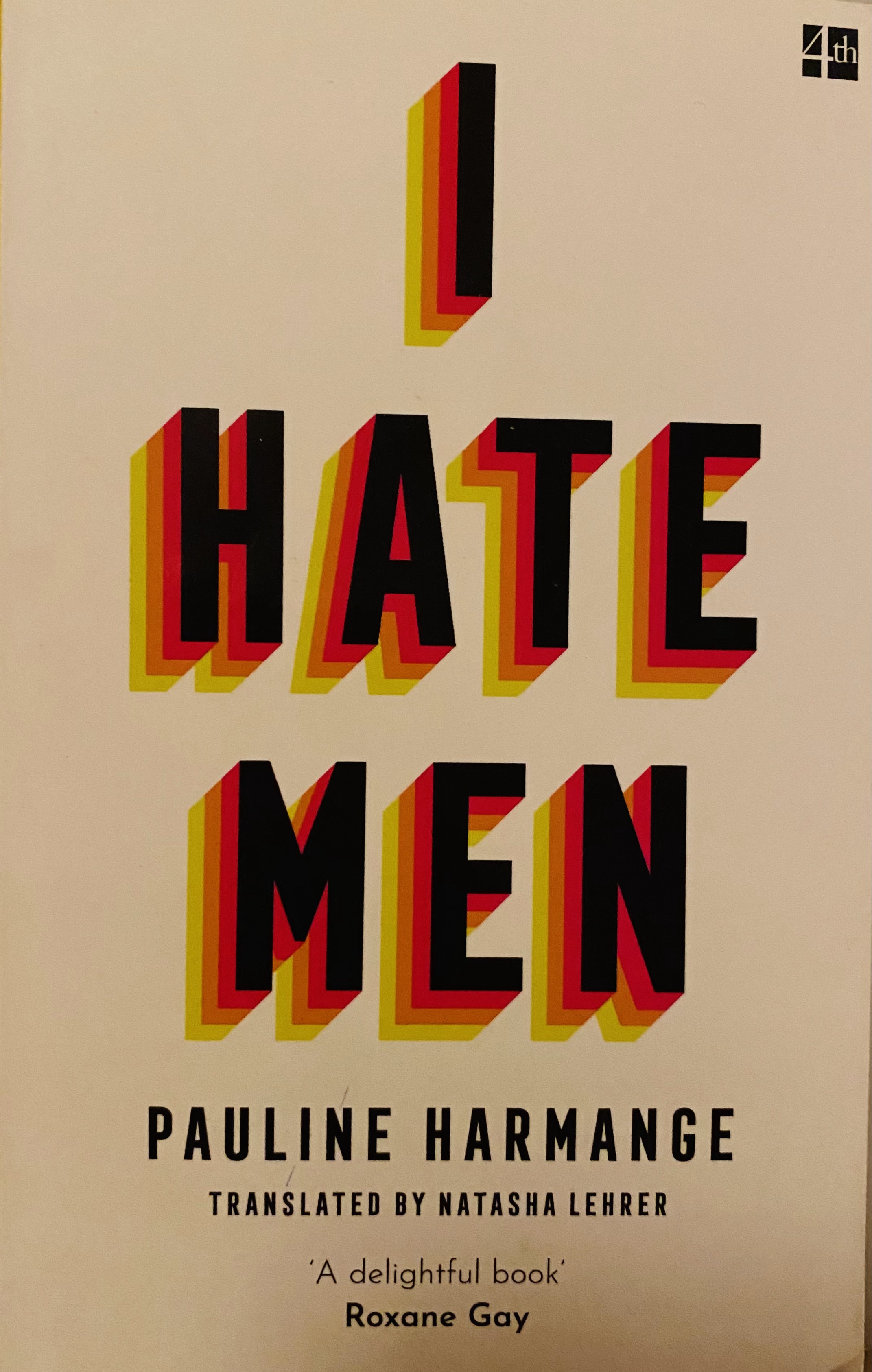
I HATE MEN, Pauline Harmange


Yesterday, I went out for dinner.  Sitting on the table next to me were two men, I would guess in their early fifties.  They were all low-slung jeans and bomber jackets and the obligatory paunch.  They, well, one of them, talked really loudly about a lot of shit: cars and nice restaurants he'd eaten in.  Whenever the young waitress came to the table he made lots of funny, suggestive, flirtatious jokes.  I say funny but I suppose I mean gross and revolting, more accurately.  During one hilarious interaction he told her that he and his fat friend were going to be waiting for her after her shift to take her out and show her a good time.  And the young girl smiles and tries to pretend that she's enjoying the sad banter from the ageing dullard.  Why does she?  I guess it's her job to some extent but I also guess she knows that if she is sullen, if she fails to laugh at his 'jokes', perhaps even, if she tells him to shut his leering face, at that moment he will turn.  "Can't you take a joke?" "Takes herself a bit seriously, doesn't she?" "Must be on her period" Some examples that might be fired at her.  She will unlikely have the upper hand in this situation, she will unlikely silence him.  And it was at this moment, as at many moments, when I would have liked to have handed her 'I Hate Men' by Pauline Harmange. This small, mighty book, more of an essay, in fact, should be handed out to all girls around the age of fifteen.  This is an age when they are mature enough to engage but young enough that the patriarchy has not solidified their way of thinking into a defeated acceptance of misogyny; into a mindset of, how do I avoid misogyny? Be pretty, be slim, take up no space, be quiet, smile, care, breed, don't breed, be sexy, be chaste etc etc etc.  Rather, suggests Harmange, turn your world on its head and take a totally different approach.


Harmange's argument is that misandry is not just a legitimate response to misogyny, 'a principle of precaution', as she puts it but a way of fostering a new-found sisterhood.  Misandry would pose no threat to men, not in the way that misogyny poses to women.  The playing field is not level.  We will not, through our hatred of men, become rapists, murderers, stalkers, domestic abusers as men are but rather we will come together as a necessary means of action.  The book is, perhaps contrary to the impression created by the title, incredibly optimistic.  Harmange ends with, 'Soon the patriarchy will topple and we shall dance among the ruins of the old order.'  It certainly made me want to dance.  My favourite chapter was 'Mediocre as a white dude' which, as well as being insightful, was very funny; there is nothing dry about this little book.  Harmange gives excellent advice when she writes, 'Whenever I'm beset by doubt, I think about all the mediocre men who've managed to make their mediocrity pass for competence.' She puts a little Asterix here *You know exactly who I'm talking about.  Hahaha, which nation's leader would you pick?


Few things are more powerful than a writer who takes your defeat and pity and shame, seems to recognise it accurately and invites you to turn all of it into anger.  Unapologetically this is what Harmange does and it is liberating and poignant to read the angry words and the call to arms; 'Our anger insists that men take responsibility for their behaviour and spurs on our revolution.'  I wish that I had had this book when I was younger.  Harmange, it will be no surprise to learn, is French.  When the book was first released in France there was a media frenzy after somebody (a man, obvs) tried to get it banned.  It garnered some lucrative notoriety through this, although I don't believe that it ever was banned so you are able to go out and buy many copies and hand them out to your nieces and daughters and maybe, even, the odd man.

Saturday, 9 July 2022

Instagram


I recently took two of my older children on holiday for a post-exam city break to Palma de Majorca.  It was hot, there was a pool overlooking the harbour.  We spent quality time together without their younger siblings.  We explored the city, ate tapas, swam in the sea.  How lucky we are.  Equally, the hotel we stayed in was crap and under-staffed, water poured through our bathroom ceiling at one point and we had to change rooms.  It was two miles out of the city with very little in the way of entertainment close by.  Everything was twice the price that we would have expected.  Evening meals did not come in at under a hundred euros. We all shared a room and I discovered that both my children snore.  In some kind of fiendish plan, if I got one of them to turn over and thus cease, the other would then start up.  I was permanently exhausted.  Then there were the arguments about how we would spend the day, with my son always up for some kind of expedition and my daughter wanting to drink (expensive) cocktails by the pool all day.  And then our flight was delayed by 24 hours necessitating and extra night's accommodation and a lot of plans rearranging.

My instagram feed was, perhaps inevitably, full of pictures of the bluest skies and seas, myself from a strategic angle in a bikini, delicious food and beach vistas.  This is how my Instagram feed looks.  I saw this quote above today and I thought, 'well, of course!' Does anybody not realise this? But it seems that some people consider only posting the best bits to be inauthentic.  I take issue with this.  There are plenty of accounts that you can follow if you want to zoom in on misery and I think that's fine.  Make this space what you want it to be.  For me, Instagram is scrap-booking.  It has an almost entirely aesthetic value for me and these are the sorts of accounts that I follow.  I will hold my hand up and say that I quite wittingly cherry-pick the best bits and post those.  Sometimes, the weeks are full of nothing but shit and then there is some beautiful light filtering through the trees and I capture it and share it and cling onto it.  I do this because it makes me feel better, in the moment and when I look back.  It seems like the moments of quiet loneliness, where things go wrong and we wonder why we bother, and getting up and functioning is hard; these moments look after themselves just fine. But if we're not careful, in a landscape of constantly negative and frightening newsfeed, the precious moments might just get lost in the noise.  That isn't to say that I am advocating suppressing sadness or gaslighting our own travails.  Rather, take it to counselling.


If this sounds like an environment of fakery, I would argue that the connections I make on Instagram, although physically distant, are incredibly energising and, yes, real, to me.  You really can bond over a mutual appreciation of beauty, with people outside of your four walls, your town or your country.  What moves somebody speaks volumes about their inner life and values.  I will never trivialise the significance of a new dress or cushion because these are the things that distract us with their colour, they allow us an outlet of creativity in a largely uncreative world.  And it is the colour that I am seeking on Instagram.  I follow relatively few blue tick accounts because they are often not curated by the account-holders themselves, and I follow even fewer accounts set up to promulgate a single cause.  I have long since done away with Twitter and Facebook because of their bear pit environments but the little squares of people's precious moments helps me to feel connected to a bigger world than my immediate environment.


When I look back at my holiday pictures, courtesy of Instagram, where maybe I've cropped out an unsightly building or lightened the exposure so that our expressions are more visible, I am reminded of the ornate architecture that I may never see again, the heat on my skin, the aftermath of a joke, how nice my new dress felt to wear.  If Instagram didn't come along when it did, I would've continued to make scrap books and albums, the only difference now is that more people get to see my pictures (lucky souls).  Someone from my hometown, I discover, has just visited the tiny town on the north coast of Majorca that my son and I travelled to by train.  These tentacles of appreciation and connection are new but shouldn't be viewed suspiciously.  Let us at least allow that the digital age has some good in it.

Wednesday, 8 June 2022

BEAUTIFUL WORLD, WHERE ARE YOU


        'Aren't we unfortunate babies to be born when the world ended? After that there was no chance for the planet, and no chance for us.  Or maybe it was just the end of one civilisation, ours, and at some time in the future another will take its place.  In that case we are standing in the last lighted room before the darkness, bearing witness to something.'


Sally Rooney is a young and brilliant writer, accurately capturing the hesitancy of the zeitgeist.  I say this before I write a somewhat critical review of her latest offering.  Beautiful World, Where are You (without question mark, so passé) has divided my social media feed ever since it came to publication, so I had to delve in and see for myself.  Like her previous novels, Beautiful World explores the relationships between four characters who, in this case, are a bit older, all hovering around the significant age of thirty and in the grips of existential inertia. The passage above seemed to me, when I read it, to sum up the heart of the book and also encapsulates, nebulously, my own view of the younger generation.  Because, although Rooney's characters are a little older in this novel, she is still really writing about a younger generation.  These characters live in house-shares, are unmarried and childless, essentially only responsible for themselves but nevertheless, carry with them a great weight. What is the weight? 


It is what I notice in the young: A caution and a cynicism that stops them in their tracks.  A lot of the novel focuses on the female characters' inability to prostrate themselves for the men that they profess to love; to hold something of themselves back at all times.  As a feminist, I feel that I should enjoy this as a manifestation of female power, except these characters are definitively without power.  And as a reader, I would love at least one of the characters to prostrate themselves for something, to run towards the fear, to care, to indulge.  Because then, something might actually happen.  It is tempting, whilst reading, to feel that the main thing weighing on these young people is their astoundingly boring personalities.  They may indeed be very real.  Rooney is concerned with what is real now, which is why the long emails between the female characters that form a big part of the narrative are, I assume, her own stream of consciousness.  At times, I wasn't sure if I was reading Alice's or Eileen's words.  They were largely interchangeable.  The content of these emails was genuinely interesting and I would welcome a book of essays from Rooney but it was a little lazy.  The two male characters were much more identifiable because they were so different.  Perhaps Rooney only really knows women who are like herself, or Alice, or Eileen.


So it's a novel where not much happens and this is my natural terrain as a reader.  Only, Rooney is not much bothered with giving us any aesthetic pleasure from her prose.  It is frustratingly and presumably, deliberately, flat. At the end of the non-epistolary chapters, the narrative switches to the present tense where the narrator gives an overview of the scene that has just played out; a sort of zooming out of perspective which is deliberately visual.  In this way, the nod to cinematic effects and the flat prose suggest that Rooney is now so secure in the knowledge that her novels will be televised that she is jumping ahead and writing for the screen.  Or, that her natural medium is actually drama.  In a recent interview, Rooney claims that her prose is 'secondary to the characters'.  Perhaps she might consider, in her next novel some attempt at using language to elevate or provide humour, or, goodness me, perhaps to entertain.  No spoilers here but don't pick up a Sally Rooney novel if you're looking for humour. I think the best way of describing this book is in culinary terms.  It will do you good and as such, it is uncompromising in its wholesome credentials but in order to really enjoy it, which I believe Rooney would consider basic, you need to refine your palette.

Monday, 23 May 2022

A Year of Sobriety

"I bet you feel amazing when you wake up in the morning?"


This is the question that I am asked most often.  And the answer?  Of course not....I'm a 43 year old, peri-menopausal woman.  I wake up (if indeed I slept) with stiff, achy joints, a head full of cotton wool and puffy, blind eyes.  This though is why I am so relieved that I no longer drink.  Imagine, I think, inside my foggy brain.... imagine if I had also downed a bottle of wine last night.  How absolutely disgusting would I feel then?  So, it is not that I jump out of bed with renewed vigour every morning since I gave up the booze but rather the opposite that sells abstinence to me.  I am no longer regenerating and I need to be kinder to myself.  That's the physical element of not drinking and whilst we're there, I should add; no, I have not lost weight.  I have, in fact, gained weight.  Because, what I used to do sometimes (well clearly enough times to count for about half a stone of flesh on my hips) was drink instead of eat.  Also, when you're taking in so much sugar from alcohol you have zero appetite for it in other forms.  "I don't have a sweet tooth" was a thing I had actually been known to say.  Well, take all that alcohol away and your body doesn't accept it without a fight.  Suddenly, I crave chocolate.  Chocolate!  Like some kind of Bridget Jones stereotype I resort to eating cooking chocolate because my body needs its hit of the sweet stuff.  


It's all fine though because, fatter and older I may be but I have so much more time to play with, and head space to enjoy the things that I actually enjoy, rather than things that I pretended to enjoy.  Like, er, parties, or socialising after 9pm.  The other day, I walked past a bar that I used to enjoy frequenting.  The sun was shining and people sat by the river drinking Aperol Spritzes and I had a moment of longing but for what?  I went home and sat in my sunny garden with a cold glass of lemonade and my book and it was bliss.  What was I missing, really?  There was some sense of FOMO, I suppose; because the people at the bar looked so overtly happy.  But had I once looked happy when I was on my fourth Aperol and talking shit to deaf people I cared about not at all, whilst feeling a bit queazy and increasingly dizzy and pushing from my mind the knowledge that I was probably making a tit of myself and storing up a stinking hangover for the next day?  


For a long time I had tried to control my drinking with various ingenious but ultimately ineffective strategies.  There was the classic 'only drinking at weekends', which was fine if you didn't go on a bender at the weekend.  Or fine if you didn't go out on a Tuesday night and break your own rule and then have to write off the whole week. Then there was the '3 nights on, 4 nights off' strategy.  This was my most recent self-imposed rule that I would find justified ways of bending.  Ultimately, if you are drinking on fewer nights than you are not drinking, you clearly don't have a problem. Yes?  You are not drinking more than you are drinking, so how can you have a problem?  Even if your 'on' days start with brunch + Champagne and carry on in a similar vein.  Even if you look for reasons to drink excessively on your 'on' days.  Still, how can you have a problem if you are 'off' more than you are 'on'.  Then there was the 'two drinks' strategy.  I will drink whenever I feel like it but I will never consume more than two drinks.  Clearly, that one was never going to be terribly successful if you lack the moderation gene, and this is important.... over this year of sobriety, the people who do not, or cannot, understand, are those for whom excess never features in any form.  Those who understand are often the very best drunks, the people who seem to be, as Churchill said, getting more from alcohol than alcohol is getting from them.  Those people understand that for those of us for whom the pendulum swings from one extreme to another, moderation is not a choice that we have.  In this way, giving up alcohol has almost been too easy for me.  Can I control defensive patterns of behaviour, unhealthy eating habits or my problematic relationship with my body in the same abstemious way?  No.  But alcohol serves no purpose.  It does not serve and can be cut completely.  Once it's gone and you realise that life goes on, much the same as before but so so so much better, you forget that it ever took up so much of your time and thinking.  


I want to make clear that the only person who can tell you that you have a problem is you.  I am not pretending that I had a physical dependency on alcohol.  In this country, we are conditioned to see problem-drinking as the park-bench men who swig from vodka bottles wrapped in brown paper.  People with a drink problem are outside of society.  They are not the mum who sinks a bottle of Prosecco every night or the business man whose enjoyment of long, wet lunches marks them out as people who 'like a drink' or are 'the life and soul of the party' etc.  In other countries, particularly the US, the bar is set much lower.  By the standards of the US, most Brits are problem-drinkers.  The sober movement over there has, rather unhelpfully, been hijacked by American Christianity.  As you can imagine, this creates a divisive system of judgement that seeks to label and polarise.  There should be no judgement here.  Alcohol is a highly addictive drug and we are encouraged to partake at all social events.  People even allow their children to take the drug.  Some encourage it for that indefensibly idiotic reason that they want their children to grow up to be responsible drinkers.  Sure, not just any old drug-users but responsible drug-users.  We need to address our cultural relationship with alcohol in this country.  I wanted a punchy, humorous ending to this piece but I find that what was initially an incredibly personal life change feels political, now that I look around with this clear-eyed, much prized sobriety.


Friday, 11 March 2022

I N S O M N I A a brief enquiry

 For the past two weeks I have endured one of the worst bouts of insomnia that I have known in recent years.  I average four hours a night.  Having reached the stage of desperation and crying down the phone to the GP I have exhausted the medical options. Although, I'm hugely grateful to my GP for his kindness and his instruction to me to "go for a little run, buy this book I'm texting you the details of and take whatever drugs you need to get through"*. I have been prescribed Sertraline, Diazepam and Beta Blockers.  Nothing gives me more than Margaret Thatcher's four hours.  Nothing really addresses the racing heart and thoughts and, oh God, the sweat. All my so-called natural processes feel blocked; the breathing, the eating, the fucking and of course, the sleeping.  Perhaps you are reading this and apart from reeling from the over-sharing you are saying the word 'mindfulness' to yourself.  Well, mindfulness is a wonderful theory.  I'm a therapist and I get it but I am still not sleeping.

But here's the funny part.  I am OK.  I am on high alert.  The anxiety infiltrates every cell in my body.  It's not nice. But, having reached the sharp end of tearful exasperation I am now at a point where I realise that all efforts to push the insomnia and anxiety aside are counter-productive.  It takes up too much of my precious energy but to no end.  The only path now seems to be to invite these insistent bed-fellows to the table, to accommodate them as best I can and to hear what they have to say.

I don't know what they are trying to tell me, except perhaps, that for so long I was living for others rather than myself and now I am being forced to pay attention before it is too late.  But I know that all growth, for me, is painful.  I have gained the greatest insights about my own identity from suffering.  Carl Rogers called it the actualising tendency, the urge in all of us to grow towards the light.  But some people never actualise much.  Their self-structure is rigid and they are reasonably content with their predictable lives, lived within a small, safe comfort zone.  Still, theory has it that the tendency is there in all of us.  My own therapist has a slightly different take, she likens it to shaking up a bottle of fizzy liquid and unscrewing the cap quickly.  I am aware that my preference is to unscrew the cap very slowly.  To have complete control over how the pressure is released but this may not be possible.  For now, one of the obvious consequences of being tired is being tearful; a heightened emotional response to everything.  Rather than seeing this as an inconvenience I am trying to see it as a new power, an elevated empathic ability.  The words of Rogers seem potent to me right now when he states:

"This process of the good life is not, I am convinced, a life for the faint-hearted.  It involves the stretching and growing of becoming more and more of one's potentialities. It involves the courage to be.  It means launching oneself fully into the stream of life.  Yet the deeply exciting thing about human beings is that when the individual is inwardly free, he chooses as the good life this process of becoming."


*words to that effect

Friday, 19 November 2021

Mothering Sunday (Film)


 Mothering Sunday is a film based on the novel of the same name by Graham Swift.  I have not read the novel and for this I am glad but in its themes it is reminiscent of 'The Go-Between' and 'Atonement', two novels that I particularly like.  However, Mothering Sunday finds another way into the subject matter of the loss and aftermath of the Great War; that territory where the cultural tectonic plates had shifted so cataclysmically that the inhabitants were walking on sand; ungrounded and shell-shocked beyond hope.  The story deals with the idea of who tells these stories and the answer is as old as time.  The outsider tells these stories because the imaginative outsider sees all the players with some degree of detachment.


In this case, the outsider is Jane Fairchild, an orphan who works in service for a Mr and Mrs Niven.  Said couple have lost both their sons in the war.  On a fine Mothering Sunday in 1924, Jane is given the day off whilst Mr and Mrs Niven join their friends for a picnic.  Jane, played by Odessa Young, takes herself by bicycle to a nearby estate where she resumes her illicit affair with the remaining son of the Sheringham family.  Paul Sheringham is played by Josh O'Connor.  I worry a little for O'Connor who seems destined to be Prince Charles forever.  But his performance as Sheringham required a certain amount of the young Charles so he was well-cast in this instance.  Young is a fine actor whose pre-Raphaelite hair was a character of its own.  I wanted to reach into the screen and stroke it.  And I shouldn't think I was the only one who wanted to reach in and stroke; the nudity was at once tasteful and real, and if I were to sum up the film as a whole, that wouldn't be a bad description - tasteful BUT real.  The realness was exquisite, more real than reality, it possessed a certain technicolour authenticity which felt at times like a special effect.  We could see the spots on the actors' faces (and their arses), the hair on their bodies, the colour in their cheeks, the slightest lines on their faces; every nuance of expression was communicated with subtlety but illumination. There was something about the quality of the light which gave the impression of looking back on a dream but also, making that dream touchable and alive.


The story panned in and out from the personal to the broader cultural context.  After their vividly rendered (but tasteful) lovemaking, Sheringham leaves and Jane has some time to occupy herself in the big house by herself.  This was one of the memorable moments.  Young can easily carry a scene by herself and her character's curiosity for the house and for her lover were related with such an enchanted innocence.  Big houses aside, there was something of the universal post-coital experience, the return to oneself after unity which was compelling.  Whilst within the house, the music by Morgan Kibby, an eerie piano refrain, built a sense of suspense, which we only understand afterwards when the dreadful event that constitutes the plot climax comes to be known.  Afterwards, all that is left from this passionate encounter is a stolen orchid flower head stuffed into Jane's corset.  Her time in the house with Sheringham becomes Jane's 'secret', the one truth that she chooses not to share in her future career as writer.


The whole cast was solid but Olivia Coleman deserves a special mention.  Her character, Mrs Niven, carried the despair for the other lost and bereaved characters.  In a film that dripped with sadness, the scene where Coleman's character breaks down felt like the emotional climax of the film.  It is moving even now to think of her trembling hands covering her face after her shriek of, "They're all gone!" as the tears streamed down her cheeks.


As I left the cinema I felt completely and calmly satisfied, the subtlety and lusciousness of the story-telling should win director, Eva Husson, some awards in the future.

Saturday, 18 September 2021

The Comedy of Errors, Garden Theatre, 11th September 2021


Live Shakespeare is back, the same but different.  In Stratford, the current run of The Comedy of Errors is being performed in the imposing, outdoor Lydia & Manfred Gorvy Garden Theatre.  The RSC states that it is 'a ready-made, sustainable theatre which can be reassembled for other uses in the future'.  Presumably they mean, when pestilence strikes again.  But so it has always been with theatres, the original Globe having been moved from the north bank of the Thames, over the water to Southwark, its current resting place.  Theatres, more than most establishments, have to be able to adapt to the demands of the zeitgeist.  And so it was that the outdoor theatre added something organic and alive to the performance that I went to see.  The daddy long legs that darted into your hair as they were caught in a frenzied dance in the theatre spot lights seemed evidence of the charged air that the performance, and its audacity, created.  When we were seated at 6.30pm we had to wait a further thirty minutes for the show to start due to microphone issues.  How exciting, to be part of something so precarious.

The RSC has pulled out all the stops with this interpretation of The Comedy of Errors, looking to give one thing only to its post-pandemic, much-needed audience: Laughter.  It delivers with bells on.  From the very opening, the sophistication was obvious, as Ephesus was a creation that might be loosely seen as 1980's Dubai meets Dynasty, which, given the themes of money and trade that form the backdrop to the main plot, was inspired and apt.  In his telling of his own story of shipwreck and heartbreak, Egeon's words are set to life by the other cast members who sway in unison to indicate that they are aboard ship.  Straight away, these clever tricks of storytelling help to make the plotting of the play very clear.  Because, the great danger of the mistaken identity plays is that the audience becomes too confused in the ensuing plot confusion.  And the confusion was displayed with energy, innovation but above all, joy.  The cast seemed to be having the time of their lives and it was infectious, the audience gave it right back to them with whoops and applause throughout.

There were many notable scenes of humour, in fact, if the text allowed it, there was a play on words in every scene.  If not there was slap stick farce and ridiculous costumes to keep up the comedy.  Alfred Clay's Doctor Pinch as yoga instructor/charlatan is hard to forget, his tiny hot pants a source of humour in their own right.  Equally, the restaurant scene, in which Dyfrig Morris, as waiter, nearly loses his toupee in Antipholus' supper was pulled off with such Monty Pythonesque straight acting that the audience was rendered hysterical.

    "There's no time for a man to recover his hair that grows bald by nature."

Too.  Much.

Play within a play was used to brilliant effect when Antipholus and Dromio of Syracuse discuss the kitchen wench.  Both characters acquired microphones and performed the lines as if they were delivering a stand-up comedy routine.  At one point, Antipholus asked the audience to bear with them as the jokes were over 400 years old.  It worked.  It was new and it worked.  The RSC has to innovate but sometimes they miss the mark.  Not this time.

Director Phillip Breen, on learning that his Aemilia (Hedydd Dylan), was pregnant and due in December, decided to incorporate her physical state into the performance.  This worked so well that I heard a couple, on leaving the theatre discussing this and deciding that it must be a fake bump and part of the play's text.  You can see why they would think this.  Aemilia being pregnant becomes like a ticking bomb to the great confusion of the play.  Given her condition, her increasingly erratic and wild diatribes to Antipholus seem entirely understandable.  It seemed to give her a licence to ramp up the crazy another notch.  Dylan was the shining light of the cast and, knowing that her bump was real, I genuinely feared that the exertion (at one point she adopts a side plank and if you know, you know!) she put into the performance might result in her going into labour on stage.  I'm sure Breen had a strategy for that as well.

The Comedy of Errors is a play that has a lot to say about madness and identity.  The madness gives a lot of laughs but it is the resolution and reunion at the end that render our characters whole.  It is a profoundly hopeful play and the perfect choice to open the season and resume our new normal.


Thursday, 9 September 2021

The mid-life bikini selfie


I read with interest a recent article by Polly Vernon for the Sunday Times in which she tells of how she loses approximately fifty followers whenever she shares a picture of herself in a bikini.  More specifically, she loses female followers.

Discussions around women and body image are not new.  But Vernon is 50 years old.  She has told in articles before of discovering exercise at the age of 40 and marvelling at the ways in which it changed her body.  It is understandable then that she might want to share a picture of herself smouldering in a tiny bikini in a spirit of marvel, a sort of look-what-I-did.  Or you could call it showing off, something that previous generations of parents were all too keen to warn their children against regularly.  Less so nowadays because we are more careful with the concept of self-esteem; we are aware that this is something that our children might just need.  The young girl who does not like her body may be susceptible to eating disorders, the woman who is not comfortable in her skin may not push herself forward in the work place like she should.  Except, when it actually comes down to it, we do not appear to like the reality of women revelling in their bodies.

As a teenager, I did not like my body.  Or rather, I was not comfortable inside it.  It felt like the wrong type of body.  I wanted a supermodel's body.  I did not want my hips or my bottom and ironically, I did not want quite such buoyant breasts.  Of course there is a sad irony that it is at the time when our skin is peachy and our curves pert that we often are least comfortable in our bodies.  Still, I was saved from indulging this particular form of inhibition by having children when I was very young.  Oh the relief, to find that your body only needed to be useful.  And it was.  For over fifteen years it gave birth to and then nourished five children.  My body had purpose.  I could withdraw from any silly notions of liking it.  It did not have to bring me pleasure, only to serve others.  I had risen above vanity!

I remember one summer's day, when the youngest was tiny enough to be in a sling, and we had visited a National Trust property for the afternoon, noticing a group of elderly friends seated at the cafe table next to ours.  I watched their careful and considered movements, the slowness of their actions and the effort that it took to get out of a chair.  And all of a sudden, I wanted to climb a mountain for no other reason than that I could.  It seemed like a vision sent to remind me of the brevity of what we take for granted.  Our wonderful, fit, healthy bodies can do so much but not forever.  And to be blunt, we are dying all the time.  From then on, knowing that I would not have more children, my relationship with my body began to change.  Unlike Vernon, I was no stranger to exercise but from then on it took on a greater intensity; I enjoyed pushing myself beyond self-imposed limits and gradually I began to see that so much of what our bodies can give us comes from our own positive regard.  Because, if not now, when?

If not now, when?  I think this is the mantra that starts to reverberate in women's minds around the age of 40.  If not now, when?  If you have spent your whole life caring for others or doing the things that you were told were right, without much consideration for your own needs, you will wake up at 40 with change on the horizon and you will ask yourself, if not now, when?

I will never have a supermodel's body.  I will only ever have this body.  And this body is not going to look better in two, four, eight years time.  So I have a simple choice: To like it or not.  It is a choice.  If I choose to like it then I can enjoy it.  If I choose to dislike it then I will live only half a life.  So I can, it seems, look at the excess skin on my belly, my softly sagging, dimpled arse and even the pocket of fat on the inside of my thighs that will never disappear even if I become emaciated, and I can look on it all and like it.  Because life is better that way.  So if you look on my bikini selfies with, what? Disgust, embarrassment, whatever, you can fuck right off.  My children would say you're lucky I'm wearing a bikini.  I would say, if not now, when?

Wednesday, 18 August 2021

The Courier


At the beginning of The Courier, we are told that the film is based on real events.  It's always an interesting choice.  I suppose the motivation is to give the audience a little help in willingly suspending their disbelief.  But does it make the film better?  There's a type of person, and the film producers know this, who would say yes.  They would claim an interest in history that supersedes the pleasure of enjoying a story.  Hence why, sometimes, filmmakers claim 'true story' falsely, as with the film Fargo.  I must confess to feeling hoodwinked by Margaret Forster's Diary of an Ordinary Woman when I realised that it was not based on a 'real' person like the text claimed.  Of course, it poses the question, what is real?  Greville Wynne was a real salesman in the 1960s, recruited by MI6 to travel to Russia and bring home state secrets relating to the Soviet nuclear programme.  His source was Oleg Penkovsky, also a 'real' person.  But did events transpire quite like they do in the film?  Was there really a female CIA officer called Emily Donovan and if so, was she as beautiful as Rachel Brosnahan who plays Donovan?  Well, more of the spectacular cast later but the point is that the film seems to trade on this relationship between truth and lies and how identities are shaped in a landscape where everybody is a potential spy and nobody is telling the truth.


The unusual brilliance of The Courier, for me, was to be found in its humility; the way it unfolds by such a prosaic and linear means of storytelling.  Writer, Tom O'Connor does not seek to confound and it was a sort of relief but also very clever because the film builds to such a powerful but in some ways, unexpected, climax.  Equally, The Courier is a period piece that does not scream that it is a period piece.  No lingering shots of antiquated telephones or mid-century decor which is so de rigeur in historic films of today but just steady story-telling with an appropriately drab back drop.  Of course, part of the impact of this story is to be found in the ordinariness of Greville Wynne.  He really was an ordinary salesman who played golf.  He was an ordinary, mildly adulterous husband and an ordinary moderately detached father.  He was an ordinary man who did an extraordinary thing.


Wynne is played by Benedict Cumberbatch.  Initially, I thought, isn't Benedict Cumberbatch always a bit Benedict Cumberbatch?  With his peculiarly distinctive face, isn't he always, at the very least, a bit Sherlock?  But as the film opened and we witness Greville Wynne drinking his way through his average life, quietly swallowing down the ubiquitous disillusion of mid-life, I realised how wrong I was.  BC had this character nailed, with his barely disguised Estuary vowels and nervous little laugh.  As he travels backwards and forwards to Moscow, he begins to understand some of the gravity of what he is undertaking.  He meets with Penkovsky who is played by the mercurial Merab Ninidze.  I could look at Ninidze's face for a long time.  It is everything that Cumberbatch's face isn't and that is why the casting was so brilliant, they formed a sort of yin and yan of comradely loyalty that evolved before our eyes and held us as the inevitable terror ensued.  Sorry to spoil the ending for you but both men are captured and tortured in a hell-hole of a Soviet prison.  It should have been expected but because of the understated opening of the first half of the film, somehow, it was breath-taking to find that there wasn't going to be a conventional happy ending.


But this was where the film really took off.  Wynne is kept in solitary confinement and tortured for two years.  The point of torture is to strip us of our identities, to reduce us until there is nothing left.  And when we are nothing, we will happily sign anything that Soviet officials put in front of us.  Except, Wynne will not relinquish the one truth that gives his identity its essence.  He will not forsake Penkovsky. Of course, he also wanted to return home to his wife and child but the scene that brought the whole film together was when the Russians throw Wynne and Penkovsky together after months of torture in the hope that they will proceed to incriminate and denounce each other.  Both actors have lost weight for the final scenes; Cumberbatch was unrecognisably gaunt.  Of course they will not denounce each other.  Wynne tells Penkovsky that the Russians removed their missiles from Cuba and thereby backed down from increased hostilities with the USA.  The preposterous claim is that Penkovsky's bravery has saved the world from nuclear war.  But it is not preposterous in the context of this scene.  Penkovsky's days are clearly numbered but Wynne makes him aware that his sacrifice has paid off.  Unforgettable cinema!


Tuesday, 6 July 2021

Another Round


It could be said that 'Another Round' is a film about men.  Poor, misunderstood men, who live with women who have jobs and don't have sex with them enough and ask them to go shopping for things like nappies and fresh fish.  Men who have no other option but to reinvigorate their lives through the means of alcohol so that they can rediscover their lost boyhoods and camaraderie.  They can fall over a lot in the way of charming rapscallions which is above all darkly humorous in a manner that is unthinkable if it is women falling over drunk.

But 'Another Round' is a Danish film, directed by Thomas Vinterberg and so, is actually a work of philosophical exploration disguised as a dark comedy.  Friends and teachers Martin, Tommy, Peter and Nikolaj, all at various stages of that perilous lacuna we call mid-life, decide to test the theory of psychiatrist Finn Skarderud who muses that a blood alcohol content of 0.05 enhances creativity and enables a more relaxed lifestyle.  The film in its native Danish is called 'Druk' which means binge-drinking and this gives an idea of how the 'experiment' progresses.  To pad out Skarderud's hypothesis, examples are given throughout the film of successful statesmen and artists who spent their lives in some state of inebriation.  Churchill is quoted as having said,

    "When I was younger I made it a rule never to take strong drink before lunch.  It is now my rule never to do so before breakfast."

Men, eh?

The cast of the film, whilst having nailed the drunken stumble, bring much more to its heart than humour.  Mads Mikkelsen is an actor whose ability to convey pathos must be unrivalled.  In one of the opening scenes, the friends gather to celebrate Nikolaj's 40th birthday.  What better way to start any film or book or play than with a 40th birthday?  The point when life pivots for so many but for Martin (played by Mikkelsen) who is older, life is spiralling rather than pivoting.  Mikkelsen's performance in this scene is one of show-stopping sadness.  When his friends notice his wet eyes they ask him what is wrong and his response is something like, "Nothing has happened.  I don't see many people."  He is a man crushed by the great weight of nothingness.  This is what this film understands and communicates to us so effectively; that the greatest tragedy in life is not an event but an absence; an inability to live fully or to take risks.  As the men set out to recapture something of their former selves, they discover, inevitably that apart from re-setting their attitudes to life, alcohol is largely ineffectual at changing anything in a meaningful way.  Martin, Peter and Nikolaj realise that life is about human connection and seem to have some success at forging more honest relationships with those around them.  Only Tommy, however, finds that alcohol fills his life entirely and once his alcoholism is known, decides to take his own life.

The revelations of the film seem to retell my own relationship with alcohol from an enthusiastic teenager to a disillusioned forty-something, all condensed into two hours.  Indeed, this seems to be Vinterberg's intention also because his initial screenplay was inspired by the excessive drinking habits of the Danish youth.  As it developed the scope of the film expanded but the antics of the teenagers that the men teach provide a heady portrait of youth binge-drinking.  As if to confound basic moralising the film ends on a joyful high as a drunken Martin dances expressively with his graduating students, all the time knocking back the alcohol with greedy abandon.  As he leaps into the water for the final freeze-frame, the message seems to be that temptation is a natural part of life.  We do not have to deny ourselves always but living life to its rich fullness requires profound bravery.

Tuesday, 8 June 2021

Alcohol: Some of the 'best' times you'll never remember?


Viognier, Whispering Angel, Aperol Spritz, Champagne, Negroni, Espresso Martini....


These have been some of my favourite tipples over the years but not now.  Now, you'll find me experimenting with mocktails, trying to find drinks that are not so sweet that you could only tolerate one in an evening.  The key is Everleaf Marine and I think you'll only know this if you've tried to go alcohol-free in the capital where this seems to be the go-to mocktail ingredient of the moment.

I am only 17 days into my sober odyssey but that is seventeen days that have included two lunches with friends, one fortieth birthday celebration and two weekends away (I know, my life!). Seventeen days would appear to be the point of evangelical enthusiasm for the crusade but keep reading, all the same. I am an aficionado of Dry January but my strategy during that dark month is to hibernate and turn down all social engagements.  A sort of penance where life is put on hold for four weeks by way of a sort of new year detox.  This time has been different because the calendar was full in a post-lockdown frenzy of social engagements.  Life was going to continue and I was going to say the words, calmly and assertively, "No thank you, I'm not drinking."  "No, really.  That's very kind but I'm not drinking at the moment."  "Really, you go ahead, I'm fine with my eighth Virgin Mojito!"

Except, when I was first required to assert myself, at my sister's 40th, the peer pressure was not forthcoming.  In fact, I found myself in a group where half of us was driving and the other half was not bothered one way or the other.  This was not what I was expecting and in fact, was in some ways, worse. I tried to encourage the non-drivers to drink.  I was close to ordering their drinks for them because otherwise I was going to find myself seated in a restaurant with other sober people who weren't drinking wine with their meal.  Was I part of a boring crowd? (horror face emoji) People might think we were Americans (horror face emoji) And here's the thing, as all these new-found prejudices came flooding out of me, it felt quite good.  It was a feeling, an honest part of a social anxiety that perhaps most of us have and certainly a lot of us choose to disguise by knocking back our first two drinks pretty quickly so that we are the dazzling company we believe others want us to be.  And if we could only stay two drinks up the whole night.  How we chase the two-drinks-up point of alcohol zenith that is so fleeting, the pursuit of which leads to unsteadiness, over-sharing and, once you sail past midnight, quite often, tears.  

But that is nothing when compared to the after-effects.  We call it a hangover which is a paltry name for an experience which is akin to being taken to the gates of death, with flashbacks, not of our life to date but just of the previous night.  We replay with an incessant paranoia the conversations that we think we might've had, all whilst asking ourselves, "Did I really say that.  Please, God, don't let me have said THAT!"  Perhaps you'll vomit, perhaps your head will explode, your hands might shake for at least 48 hours afterwards, you might go blind and lose the power of coherent speech and be left with nothing but wailing as a means of communication.  And if you've really misbehaved then you will get all those horrors together and eventually you will ask yourself the question, "Did I have fun?"

Inevitably, when you see your puffy and rapidly aging face in the bathroom mirror you will have to face your own existential defeat and admit that no, you had no fun.  You drank to numb the boredom and the anxiety but you did not have fun.  You do not even know what fun is anymore.  Because sure, it used to be dancing on tables but it's certainly not that anymore.  And once you start down that cerebral route of discovery, how the open road seems to twist and turn before you, offering more opportunities not fewer.  You can actually turn down the boring engagements.  You do not have to say yes to everything.  If you cannot face going to a particular party sober then, my friend, you probably do not want to be going to the party at all.  In short, you will have to find a new definition of fun and what with all those parties you're turning down, you'll have plenty of time for it.

What genuinely counts as fun at the moment is the smugness I feel when I don't drink.  After eating a delicious and bountiful meal at the Wolseley and, I must confess, nearly succumbing in a moment of weakness, I came out into the London dusk to find drunken revellers tumbling out of The Ritz, rowdy men swaying and shouting as they crossed the road looking for taxis or stumbling onto their next bar.  And how I breathed in that city air and thought about the uncomplicated night's sleep I was about to enjoy and the run I would go for when I woke up.  That was a high like no other.  That was, ladies and gentlemen, self-care.  No, I shall go further, that was SELF-LOVE and it felt really good.

I think, as we get older, we can feel desensitised to so much that happens around us.  A creeping cyniscism is an understandable part of ageing.  We feel it but we don't welcome it.  What is a midlife crisis if not a final fling with sentiment; a sometimes desperate desire to feel something before we lose that capacity altogether.  So it is that I am not so frightened of the social anxiety.  I do not want to numb that part of myself anymore.  I would like to see where it takes me.  I am ready to feel the uncomfortable emotions because I've an appetite for feeling that is mostly a curiosity about myself, long overdue.  Drinking is the age old way of fitting in.  It takes such a huge effort to try and be what we think others want of us.  Alcohol conspires by whispering that we can be whoever we choose with a few drinks inside us and I've had a good run.  I've drunk with the best of them, had some of the funniest nights of my life under the influence but now I choose to be me.